Customs Clearance Xiamen For PV Cable And Storage Export
Customs clearance Xiamen for photovoltaic cable, transformers and storage cabinets. SEZ bonded export, RCEP certificate of origin, UN3536 filing, direct loading at Xiamen port.
By SeeHog Logistics editorial team
For buyers in Southeast Asia, South Asia, the Middle East and East Africa sourcing photovoltaic cable, distribution transformers or modular energy storage cabinets, customs clearance Xiamen offers a combination that northern ports cannot match, namely shorter transit times, RCEP preferential access and a mature bonded export structure. Xiamen sits on the main Asia Europe and Asia Africa trunk routes, and for many destinations it removes five to twelve days of sailing compared with routing through northern China.
Bonded zone export lets you consolidate before declaration. This is the structural advantage unique to the Xiamen area. Goods moving into the Xiamen Free Trade Zone or the Xiangyu Bonded Zone are treated as exported on entry, which means you can consolidate photovoltaic cable drums from one factory, transformer units from another and storage cabinet components from a third, all inside the bonded area, then declare a single export consignment once the full order set is complete. For buyers assembling a mixed solar or storage package from several Chinese suppliers, this removes the need to synchronise three separate production schedules against one vessel cut off. It also means your export tax rebate timing is triggered earlier in the process.
RCEP origin rules cut duty at your end, not ours. This is where Xiamen clearance delivers direct value to your landed cost. Under RCEP, most photovoltaic cable and transformer products qualify for preferential or zero duty when shipped to ASEAN, Japan, Korea, Australia and New Zealand, provided the goods meet the regional value content or change in tariff heading requirement. The certificate of origin can now be self declared by an approved exporter, which removes the original paper certificate from the document chain and speeds up your customs clearance at destination. We prepare the origin working paper for every shipment showing bill of materials, ex works value and the calculated regional value content, so your importer can claim preference without a surprise rejection.
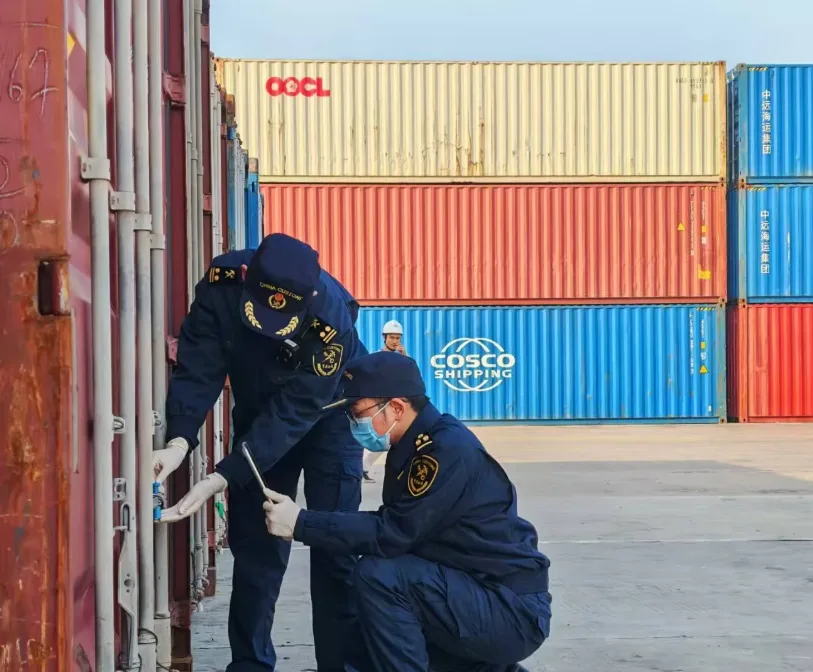
Territorial inspection still governs the pre shipment sequence. Photovoltaic cable, transformers under heading 8504 and most electrical products carry supervision condition B, so statutory commodity inspection applies at the customs district where the production unit is located, not at Xiamen. The order is fixed, inspection at the factory first, electronic ledger issued second, then export declaration quoting that ledger number. Since the 2025 reform this runs on online electronic authorization between the production unit, the consignor and the applicant unit, and where a trading company and a broker sit between factory and port, two authorization links must be live before booking. We verify both before confirming any sailing date, because a missing authorization is invisible until the declaration is rejected.
Storage cabinets ship as UN3536 with a fixed certificate set. A containerised storage cabinet shipped as one integrated unit with batteries pre installed falls under UN3536, Class 9, special provision 389, and because the cabinet is the transport unit rather than a package, no dangerous goods packaging performance certificate is issued or required. The substitute evidence is the classification society certificate plus the container certificate. Maritime filing at Xiamen runs roughly seven days before sailing and must complete before the carrier releases space, with the transport appraisal report headed in the exact name of the actual booking shipper.
Battery handling rules are enforced at the terminal. State of charge must be at or below thirty percent for all sea freight, with random spot checks and forced return of overcharged units. Under IMDG 42-24, mandatory since January 2026, UN3536 is restricted to deck stowage and must be kept at least 2.4 metres from heat sources. Internal fixing must be structural, using bolts, rivets or welding through brackets with flame retardant filler, and ordinary foam is rejected. Series and parallel circuits are disconnected and the PCS de energised before loading.
Packaging is built for humid tropical discharge ports. For destinations in Southeast Asia and West Africa we specify plywood cases rather than solid timber where weight allows, since manufactured board is IPPC exempt and resists fungal attack in high humidity. Where solid timber is unavoidable, every case, pallet and dunnage piece carries the IPPC mark after heat treatment, photographed before sealing and included in your document set. Cable drums are supplied in treated plywood with moisture barrier wrapping and desiccant, because photovoltaic cable jackets degrade if stored wet at destination.
Send us your equipment list with cable cross sections and lengths, transformer rated capacity, storage cabinet configuration and destination country. We will confirm the correct HS code, whether RCEP preference applies to your destination, the territorial inspection location, the bonded consolidation option, and the certificate set your importer needs. Email us or add WhatsApp +86 15221865538 and we will return a written routing and compliance plan for your specific order.